
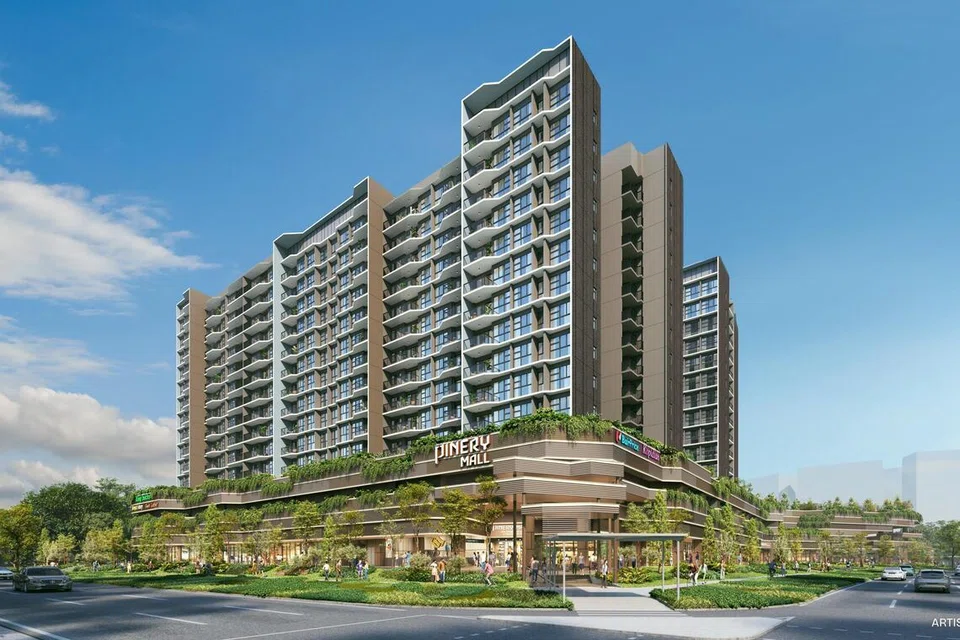
When Pinery Residences launched in Tampines, many were surprised.
Prices crossed $2,546 psf, with some units even approaching $2,700 psf — Not long ago, you could get this price at a city fringe projects.
So the natural question is:
Why were buyers willing to pay this price… and does it actually make sense?
To understand this, we need to look beyond just the psf.
1. It’s Not Just Tampines — It’s Positioned Within Employment Hubs
Tampines today functions very differently from what it was a decade ago.
It is no longer just a residential estate. It sits within a cluster of major employment nodes, including Changi Business Park and surrounding commercial zones.
This changes the demand profile entirely.
Instead of relying purely on homeowners, the area now attracts:
- Professionals working nearby
- Tenants who prioritise proximity to work
- Buyers who value time savings over distance
What this creates is a sustained and real demand pool, not a speculative one.
And when demand is anchored to employment, pricing tends to hold.
2. Integrated + MRT + School = Demand That Is Hard to Replicate
Pinery is not just another condo in Tampines.
It combines three elements that rarely come together:
- Direct MRT connectivity (Downtown Line)
- Integrated retail component
- Within 1km to St Hilda’s Primary School
This combination matters.
Buyers are not just purchasing a unit — they are buying into:
- Daily convenience
- School priority
- Long-term liveability
More importantly, there is very limited supply of condos in Tampines that are both near MRT and integrated.
That is why the pricing wasn’t resisted.
It wasn’t coincidence — it was demand recognising scarcity.
3. Land Cost Is Already Setting the Next Benchmark
One of the most important factors buyers often overlook is land cost.
Recent GLS sites have already been transacting at higher levels, which sets a new baseline for future launches.
This means:
- Future projects are likely to be priced higher
- Current launches become the earlier entry point
- What feels expensive today may not look expensive later
In other words, pricing is not moving randomly — it is being pushed upwards structurally.
4. Overwhelming HDB Upgrader Demand vs Limited Supply
Tampines has a large base of HDB owners.
Many of them are reaching the stage where upgrading becomes a real consideration.
But here’s the imbalance:
- Strong and growing upgrader demand
- Limited new condo supply
- Even fewer options near MRT (especially Downtown Line)
This creates a very specific situation:
When a project ticks key boxes, buyers do not have many alternatives.
And when choice is limited, resistance to price weakens.
A Thought Most People Are Not Ready For
Today, people are asking:
“$2,500–$2,700 psf… is this too expensive for Tampines?”
But zoom out a little further.
What if the real question should be:
“Will $3,000 psf for Tampines become the headline in 2030?”
Because if:
- Land costs continue rising
- Demand remains anchored to employment
- Supply near MRT stays limited
Then today’s pricing may not be the peak.
It may simply be the transition.
So — Was It Worth the Price Tag?
If you look purely at psf, it may feel high.
But psf alone does not determine value.
When you factor in:
- Employment-driven demand
- MRT + integrated convenience
- School proximity
- Limited competing supply
- Rising future land costs
The pricing becomes more understandable.
This is not a case of buyers overpaying blindly.
It is a case of buyers recognising:
- Scarcity
- Positioning
- And future competition
Final Thought
The market is shifting.
It is no longer just about buying the cheapest psf.
It is about:
- Where demand is coming from
- Whether that demand is sustainable
- And how easy your property can exit in the future
“Price is what you pay. Value is what you get.” — Warren Buffett