
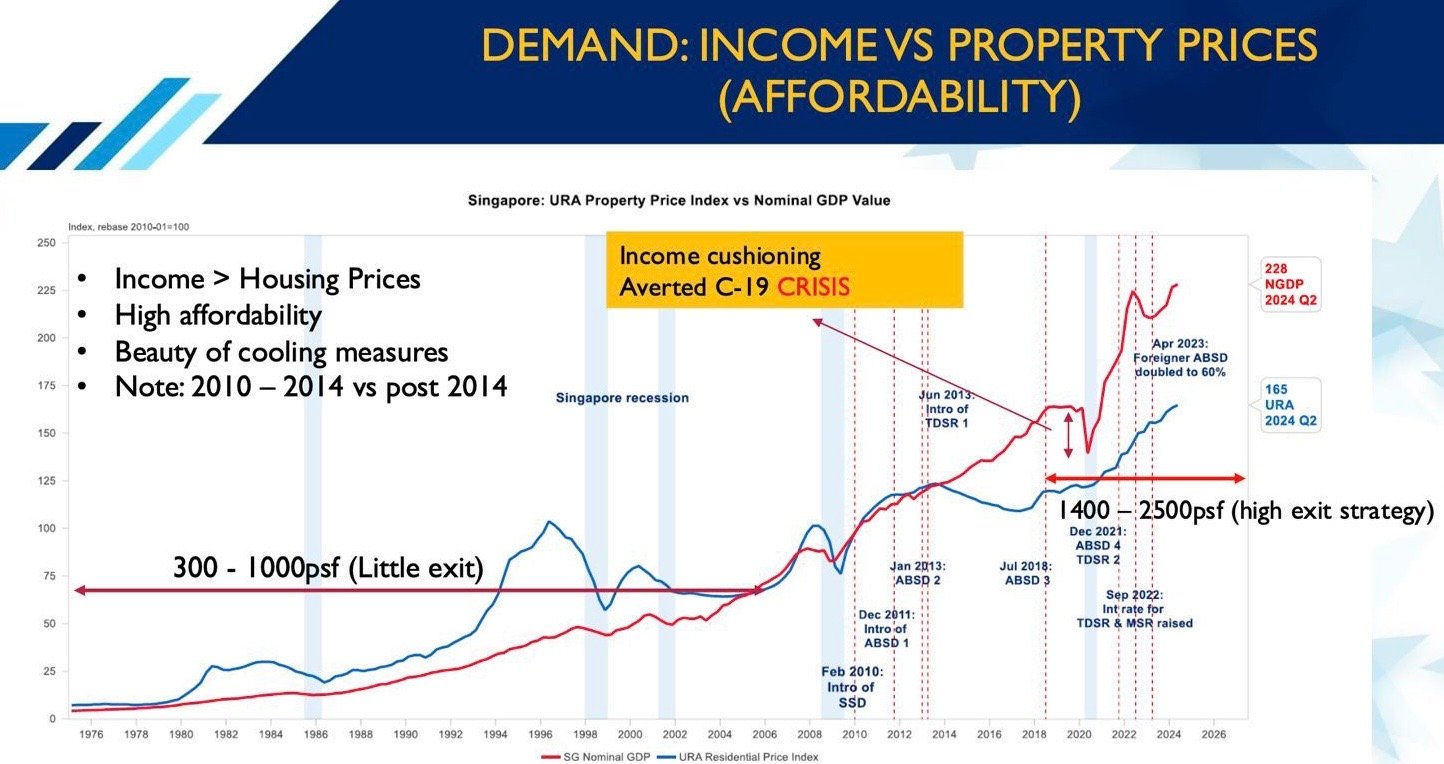
Many buyers look at today’s prices and feel uncomfortable.
“$2,600 psf? That sounds crazy.”
“But properties used to be $1,000 psf — surely that was safer?”
Ironically, $1,000 psf in the past was often harder to sell than $2,600 psf today.
Here’s why 👇
Price Alone Never Determines Exit
Most people judge safety by price level.
But markets don’t care about what feels cheap or expensive.
They care about value & affordability.
A property is easy to exit when:
There are many buyers who can afford it
Those buyers need or want that location
When those conditions aren’t present, even a “cheap” property becomes hard to sell.
Why $1,000 PSF Was Difficult Back Then
Let’s rewind.
At $1,000 psf,
Property Prices were far from affordable
Built before major transformation plans
Bought during periods with limited demand.
Dependent on hope rather than demand
All these were when there are no restrictions!:
No ABSD
High Loan to Value
no TDSR/MSR (loan restrictions)
So even though the psf number was “low”, the number of capable buyers was also low.
Low price ≠ high demand.
Why even $3,000 PSF Can Be Easier to Exit Today
Now look at today.
Prices are higher — but so is everything else:
Household incomes
Dual-income families
Loan quantum capacity
More importantly:
👉 The buyer pool is much larger.
A $3M property today may still be:
Affordable to HDB upgraders
Within reach of professionals and PMETs
Supported by strong rental demand
Located near real employment clusters
When many buyers can afford the same price point, liquidity improves — not worsens.
Exit Is About Buyer Depth, Not Always about PSF
Think of it this way:
Would you rather sell:
A “cheap” home with 10 possible buyers, or
A “more expensive” home with 1,000 possible buyers?
The second option wins every time.
That’s why some $1,000 psf projects stagnated for years — while newer, higher-priced homes today transact smoothly.
The Real Question You Should Ask
Instead of asking:
“Is this psf high?”
Ask:
“Who is my next buyer — and how many of them exist?”
If you can clearly answer:
Who they are
How they earn
Why they would buy
And whether financing supports them
Then the price becomes secondary.
Final Thought
Price growth over time is normal.
What matters is whether demand has grown faster than supply.
A higher psf with:
Clear employment drivers
Strong upgrader demand
Proven rental support
can be far safer than a lower psf bought without an exit plan.
That’s how calm, intentional property decisions are made —
not by chasing “cheap”, but by understanding who will buy after you